StamiNa+ sodium-ion
NA12100: a 12V 100Ah Sodium-Ion Battery for Solar Storage
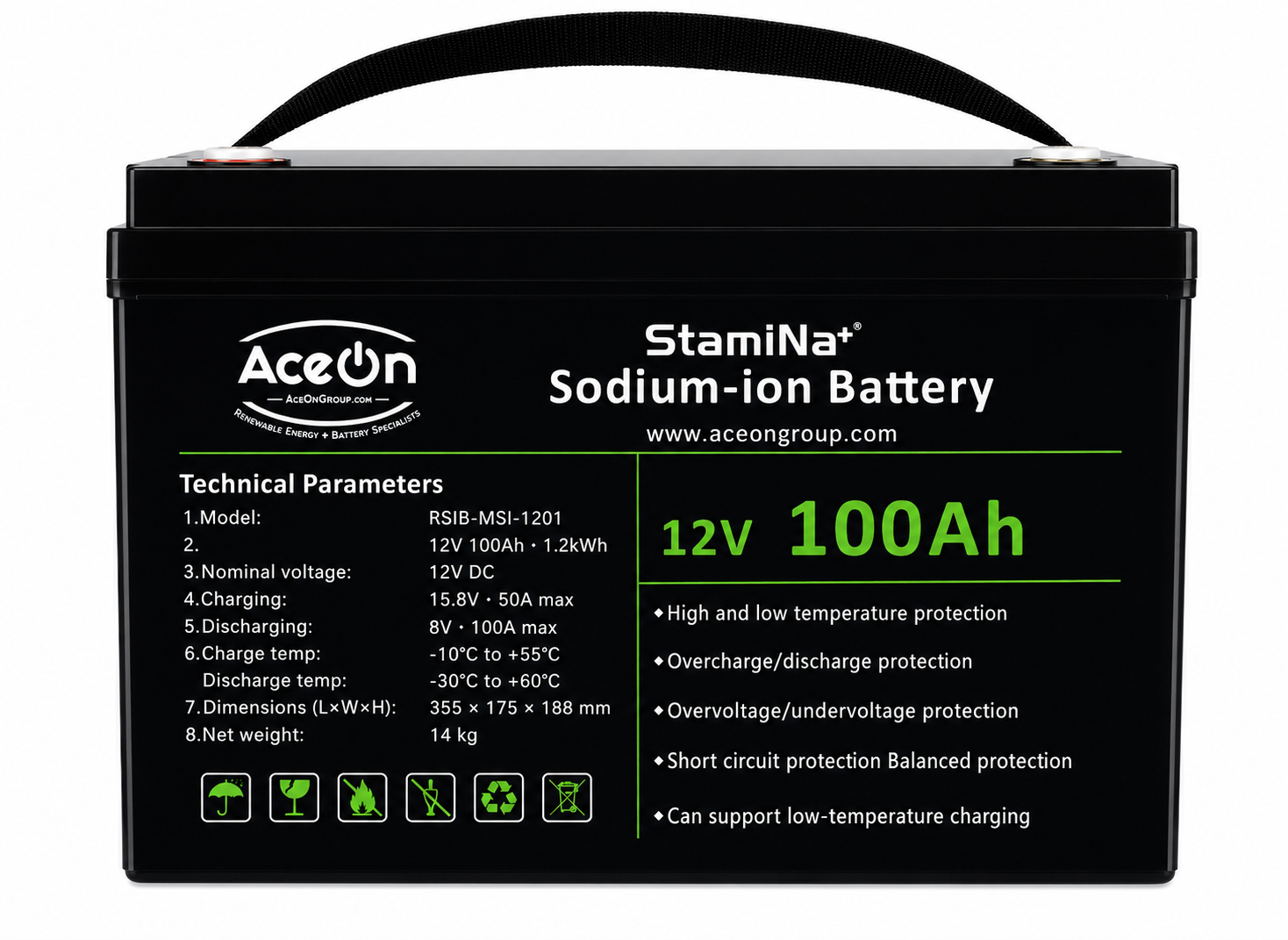
The NA12100 is a 12V 100Ah sodium-ion battery holding 1.2 kWh — the top of the StamiNa+ range and the first one with enough capacity to run a shop, a clinic, a classroom or a household through the evening rather than just charging phones.
It delivers up to 100 A, so it drives a real inverter load, and it drops straight into a 12 V system built for lead-acid — the same nominal voltage, M8 stud terminals and a sealed ABS case with a carry handle.
- Energy
- 1.2 kWh
- Max discharge
- 100 A
- Cycles at ≥70% capacity
- ≥2,000
- Weight
- 14 kg
Capacity that runs a building, not a handful of devices
This 12V 100Ah sodium-ion battery stores 1.2 kWh in a single 14 kg case. That is roughly ten times the energy of our PES Lite portable unit, and it is the point in the range where a battery stops being a convenience and starts being infrastructure: lighting a shop after dark, holding a clinic’s equipment up through an outage, or storing a day of solar generation for a household to use at night.
Inside are 32140 cylindrical sodium-ion cells in a 4S10P arrangement — four in series for the 12 V nominal output, ten of those strings in parallel for the capacity. A smart battery management system sits across them, balancing the cells and protecting against over-charge, over-discharge, over-current and short-circuit conditions.
The chemistry is the same one used across the StamiNa+ range: cobalt-free, lithium-free and nickel-free, with no thermal-runaway risk. What changes at this size is what you can do with it.
100 A discharge — the number that decides your inverter
Capacity tells you how long a battery lasts. Maximum discharge current tells you what it can actually run at once, and it is the figure that decides whether a given inverter will work. The NA12100 delivers up to 100 A continuous at 12 V nominal.
It charges at up to 50 A, so a well-sized solar array can refill it inside a day, and its internal resistance of 6 mΩ or less means less energy lost as heat when the load steps up.
If you are sizing a system around it, tell us the inverter and the daily load and we will say plainly whether one battery covers it or you need more than one. We would rather answer that before you buy.
A drop-in replacement for the lead-acid bank you already have
Most stored power in this market today sits in lead-acid batteries, and most people buying a battery are replacing one. The NA12100 is built to go where that bank went: 12 V nominal, M8 stud terminals, a sealed case with a carry handle, and no change to the rest of the installation.
What changes is the service life. Lead-acid is typically good for a few hundred cycles at 50% depth of discharge; this pack is rated ≥2,000 cycles at ≥70% capacity. It also holds up better in heat, and there is no acid, no venting and no topping up.
The trade-off worth knowing: at 14 kg it is far lighter than the equivalent lead-acid bank, but its charge window is −10°C to +55°C rather than the wider range of our smaller packs. In Ugandan conditions that is not a constraint — it is stated here because we quote per-product figures, never one number for the range.
Lead-acid figures above are typical for that technology category, not claims about any particular product or manufacturer. See the full comparison on the range page.
NA12100 full specifications
Every figure below is from the product datasheet. Nothing is estimated.
Cycle life here is ≥2,000 at ≥70% capacity — this product’s own figure. It is not the soft packs’ ≥5,000 at ≥70%, nor the PES Lite’s ≥3,000 at 80% DoD; the three are measured differently and are not interchangeable. The charge and discharge temperature windows are likewise specific to this pack. Safety: do not disassemble, crush, puncture or short-circuit. Do not dispose of in fire or water.
Where a 12V 100Ah sodium-ion battery earns its place
Anywhere a day of solar generation needs storing, or a lead-acid bank needs replacing with something that lasts longer in the heat.
Shops and businesses
Keep tills, lights, fridges and phone-charging running through an outage instead of closing early.
Clinics
Steady 12 V storage for lighting, monitoring and cold-chain equipment where the grid is unreliable.
Schools
Evening classes, computer rooms and security lighting on stored solar power.
Homes
A whole-home solar battery that runs the evening load rather than a handful of USB devices.
Need less capacity? The 12V soft packs run from 10 Ah to 30 Ah for OEM builds, and the PES Lite 120Wh is a finished portable unit for phones and lights. All three share the same chemistry — see the full StamiNa+ range.
Request a quote
Tell us the quantity, the inverter or system it is going into and the delivery location. Our Uganda team will come back to you within two working days.